How to do, "It's not about you?"

A friend of mine -- thanks, Marti! -- posted this. It's an interesting approach to the "it's not about you" neutering program I talked about a few notes ago. Will it work on the hardcore? No. Will it raise awareness amongst those who aren't even thinking about it? Yep, I think so. Good job.


http://www.youtube.com/watch?v=iG6dAnIMDys

See Foot. Shoot Foot. Foot hurt. No surprises.

Ran across another seemingly-intractable community-at-odds situation within the Greyhound world: the Grey2K anti-racing organization and the Rescue community.

Grey2K is the relative newcomer in this world. Had they sought out a focal point to relate to the existing legal industry, they might have garnered some agree-to-disagree street creds. But it appears to me that they've blown it by demonizing the scads of GOOD folks and trainers and fans and owners in the larger Greyhound world. Not sure how they can come back from where they are now.

Well, actually, I do know how they could make a comeback from it. And how they could move toward building consensus. But based on what I've seen, the odds of the organization listening to good advice aren't high. Factual misstatements and deliberately misleading characterizations aren't a good way to persuade the undecided.

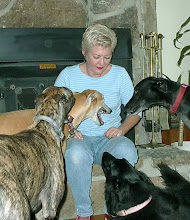
Now, in case you don't know this about me, let me just tell you up front that I've got six Greyhounds myself. A few retired racers and other assorted orthopedic cases, oops pups, and various bounce backs. I've had Greyhounds since 1998 and I love everything about 'em. Have even written a bunch of novels featuring them. Go check out dogbooks.org.

But as crazy about them as I am, I understand they're dogs, not furry little substitute children. I also understand that they love to run and that they're competitive about it by their very natures.

Grey2k proclaims: "Greyhounds are treated as simply property!"

Ah. Yes. Actually, that is the state of the law. Property laws apply.

But then again, we know how well this shrill PETA-style approach works. After all, that's why none of us eat meat anymore.

Oh. Wait.

Need some answers, folks. Not sure that Grey2K has 'em.

Spay/Neuter: it's not about you. Or is it?

I was working on my spay/neuter and community-building program the other day and ran smack-dab into an assumption I'd made -- or perhaps just an issue I hadn't thought out thoroughly.

We talk about spay/neuter as a single issue. But is it, really? Are you certain? More importantly, is it one issue as it relates to building community? That's important, because from community comes consensus.

For most of us in shelter, rescue or adoption guarantee programs (let's just call this Rescue), spay and neuter are the same issue. The differences are in the medical issues.

But outside Rescue, there's difference in initial reactions to spay and neuter and there's also a difference in the way that men and women react to them. Note -- this is anecdotal data and needs further validation.

Women tend to think about spay and neuter in the same way. If they're strongly opposed to one, they're strongly opposed to the other. If they're neutral on one, they're neutral on the other.

Not so with men. They tend to be more opposed to neuter than to spaying. How many time have you seen a guy wince when you talk about neutering his male dog?

So -- IF this is true, as politically incorrect as it might be, what does that say about our approach to building community? Seems to me that we've got some serious reframing work to do in terms of humans personalizing the issue of removing testicles. Too much identification.

Neutering -- it's not about you.

But at the same time, isn't it a failure of empathy -- or sympathy? -- that allows humans to abuse and neglect animals in other ways? And the cure for that is developing the empathy or sympathy, just the opposite in a way of what we much accomplish in regards spay/neuter.

How do we reconcile those two faces of personalization?

As my friend Jer DuFresne says: the conversation continues with you.

The Black Belt Guide to Internet Presence

Short digression: one of the questions I get asked most often is how to make effective use of social networking to build and reinforce communities. Too many people are spending hours doing it all manually when it's not all that difficult to maximize your presence by interconnecting everything.

If you've been looking for ways to reduce your workload by interconnecting your blog/Facebook/Twitter/LinkedIn and bookmarking sites, you might want to check out this ebook. It'll save you a ton of time.

That last chapter on "Advanced Friendliness" will give you some resources to take it all to the next level. Some of it I'm just putting to use myself for the first time.

Here's the link to the ebook. It's $25. You know how fast stuff changes so updates are included free for a year. Click here!

Geography and Time: You are where and when you are. Or are you?

There are a host of mechanisms in place for building and strengthening communities and I'll talk about those shortly. But first, a few more words on identifying the common interest necessary to build a community. While we talk about the common interest, keep in mind two underlying principles that can potentiate any common interest: time and place.

Geography
  1. It's hardwired -- or at least firmware wired.
  2. And it's a freebie, since it solves a lot of communication problems as well.
Always look at your group first to see if it can be characterized as a common geographic one. For instance, the spay/neuter issue might be reworked as part of a larger program of livability issues for a particular community. Martial arts folks already have this on their minds, since student recruitment tends to be driven by geography, at least initially, more than style or reputation.

Downside: by its very nature, limited. But that can be ameliorated in part by exploiting time and adding in additional strands as focal points.

Time

We've all got a past and a future and that's true of geographically-based groups as well. For instance, most martial arts, for instance (mistakenly or not), maintain some semblance of a link with their origins. All style of karate, for instance, originated in Okinawa. By definition. The word has lost that connotation in the broader community, but that's actually what karate means. That focus, of geography of origin, can serve as a focal point.

Alumni organizations would be another example of a geographic community extended by a time strand.

Similarly, FUTURE geography can also serve as a focal point. Reaching out to future residents -- or representatives of future residents, e.g. the idea of preserving the area for your grandchildren -- is also a way to expand the common interest.

Finally, find ways to interest people outside of your geographic community in the existence or issues of your community. This is not the same as expanding your geographic community. It is more along the lines of serving as a model for others -- or a bad example. "This is how we did it," versus, "This could happen to you."

Next: Causes

Spay and Neuter and the Martial Arts

I've been spending a lot of time thinking out and planning the strategy for spay/neuter programs through community building. Taking a break from it for a while, I was reading a few websites within the karate communities I follow.

Boy, talk about schisms -- karate groups are as bad as churches, rescue groups, or just about anyone else. And yet there's so much in common between all the groups, or at least so it would appear on the surface. After all, in the situation I'm thinking about, all the groups practice the same style of karate. It would seem that there's an immediate focal point to support a continuing community.

But is there, really? What is it about karate (and church administrative structures, for that matter) that lends itself to schism and infighting? Or is there really a functional community just characterized by infighting?

At least part of the problem lies in attempting to impose a foreign culture in the guise of learning an art. Many elements of martial arts that are traditional in their native lands simply don't survive the trip across the ocean. That's especially true, as Michael Massey points out in his work, when traditional martial arts are filtered through an American military mindset.

In the next few weeks, I'll be coming up with a checklist/flow chart for identifying some of these problems.

A practical exercise in community

Reducing euthanasia rates through aggressive spay/neuter policies is a practical exercise in community-building and changing. Those of us in rescue, who follow the euthanasia rates and know how many dogs and cats are homeless have a hard time understanding the mindset of people who don't spay and neuter their pets. How do we influence people whose mindset we don't really get? The local open admission shelter provides FREE spay/neuter aka S/N services to all county and city residents.

How best to influence the non-S/N people? And why? There's a mismatch of community identities at work -- the first step in influencing is to form that community bond, that focal point.

Education might change minds, but probably not.

If that doesn't work, the next technique is to identify another focal point that both the pro-S/N and the anti-S/N have in common. Often, the pocketbook is a persuasive factor, showing how much the necessity for controlling an overpopulation of animals costs each of us. There are other possibilities as well, some even more powerful, but it takes some thought and research to pull those focal points out AND establish the transition to the attitude toward S/N. It would be excellent, for instance, if pro-S/N were linked to "support our troops". While supporting the troops is a focal point that most folks will rally toward, the connection to S/N is not strong enough or even sufficiently evident (yet).

But establishing that linkage is not the first step. The first step is to list out the particular community focal points that link otherwise opposed communities.

Just in passing, one parallel might be the pro-life and pro-choice factions in human communities. The positions are essentially irreconcilable and education and cogent arguments are likely to have little effect. HOWEVER -- there are things that both sides can agree upon. That adoption is a GOOD thing, for instance. That we need to provide an alternative for desperate parents to abandoning infants, e.g. providing "no questions asked" alternatives for leaving newborns in a safe environment. Those need to be the focal points of both groups.

What are the implications for the S/N issue? More thoughts on that later. For now, it's sufficient to say that we've got to identify those community focal points before we can hope to effect true change.